Friday, November 16, 2012

Germans in your own home?

For those travelers who wish to see the world on a budget and meet locals along the way couchsurfing remains a very promising option.  If you're not familiar http://www.couchsurfing.org/ is a website that enables hosts and travelers to find people they feel they'd get along with to stay with for a period of time on travels in almost any country and any major city on earth.  While this may sound sketchy to the unknown the website has had very few issues regarding safety, feedback left by other surfers allows people to have an idea of what staying with someone might be like and if they seem trustworthy.  If you would like to meet travelers and make new friends offering up your couch to surfers is a great way to do so.  In my time of offering my couch up on couchsurfing I have met many interesting and friendly people, a majority of which were Germans.


Germans are known for their love of travel and general respect for the countries they visit, and every German person I have hosted has been respectable and a joy to hang out with.  Many German visitors I have had wished to spend time with me and my friends doing what we normally do for fun, and have been great company and provided a great outlet for me to practice my German with a native speaker.  Lots of these German travelers came from work and travel adventures in Canada to see the United States, some of them spent their first day in the US with me and I was always very happy to show them around and provide them with a great experience in Seattle.


Germans are not the only people you will meet if you offer up your couch of course.  I have hosted all sorts of travelers, from Hong Kong to Uzbekistan I have met and made great friends from all over the world.  If you are trusting in the general good of human beings and want to meet fellow world explorers than I cannot think of a better outlet than offering up your couch for them.
Steven

Time for Leavenworth!


Guten Tag!!


It is Autumn and the evenings tend to get chilly quickly. It is the season for eating tantalizing Bavarian food and listening to happy German Christmas music!! Spending Winter in Germany would be an amazing experience, but not everyone can afford for it. However, if you can experience an incredible get-away or want to feel as you have gone to Germany, you can do that in Washington state. Do you want to enjoy a little Germany adventure here in Washington? I am going to introduce you a day trip to the town called Leavenworth, two hours car ride from Seattle, also known as “German Village”.

Leavenworth, is a fascinating Bavarian village in Washington. If you want to take a break from the blue, cold, and wet weather of Seattle, take a beautiful two hours drive towards east through the mountains to Leavenworth. This German Village located between mountains has nicer weather than Seattle. In this town, you do not even feel you are in the U.S. 


There are a lot of pastry and bakeries along with many German restaurants and beer gardens. There is the one authentic German bakery called Bavarian Bakery. This bakery is run by German owner who is also known as a great baker. There is always a big line of people who want to try real German bread.  During Christmas time, their Christmas tree is decorated with their original pretzels. This bakery is also doing delivery service, therefore, many people in Seattle area can enjoy real German taste.


Bis Dann!

Randy

Wednesday, November 14, 2012

Blood is Thicker than Water

The German Men's National Football team played a friendly today against the Netherlands today.  Given the nature of this type of match (where the result doesn't impact future tournaments), the only thing on the line was pride (which is still a lot for footballers).  If you're dying to know the result, it ended 0-0.  German fans, like myself, will attribute this to the fact that Germany was fielding a team of rookies since many of their starting players were injured or sick.  Dutch fans will say this points to a new resurgence for the national team but I wouldn't necessarily bet on that one.  The Dutch squad has had it chances in recent tournaments but just can't seem to put the pieces together...sort of like the German squad (but you didn't hear that from me).

What I'd like to mention is that the headline from an article I read here declares the game between Germany and the Netherlands as "An Old Rivalry."  At this moment, my inner soccer fan was booted aside by my inner political scientist because I'd just learned about types of ethnic conflicts and my mind immediately jumped to the term Primordialism.  Now, to be clear I do not want to suggest that rivarly between German and Dutch fans mimics the conflict, for example, between Sunnis and Shias.  My mind simply started to mull over the origins of football rivalries and the ferocity with which they are often played out.

According to the article mention above, the rivalry between these two teams started when West Germany beat the Netherlands in the '74 World Cup final.  Hostilities have flared since then and no doubt resurfaced in today's friendly.

I'll go ahead and reference Franklin Foer's How Soccer Explains the World because it really is and awesome book and it really does explain a lot of things in our world.  But many of the chapters discuss passionate rivalries in particular countries around the world, some with better-explained origins than others.

The rivalry between Germany and the Netherlands is a relatively mild one (in the grand scheme of things) but it's a rivalry nonetheless; the winners will be jubilant and the losers will hang their heads and be grateful that it was just a friendly.

Rivalries big or small transform the game and it's important to give them their due attention rather than passing them off as a tool of hooligans or as something that you could never possibly understand.  We have plenty of sports rivalries here in the United States.  Think of your favorite team and the second thing that you'll think of is their #1 rival.

Mull that one over for a bit, then get back to me and let me know what you think of rivalries in football and in general.

Bis bald!

Sarah

Wednesday, November 7, 2012

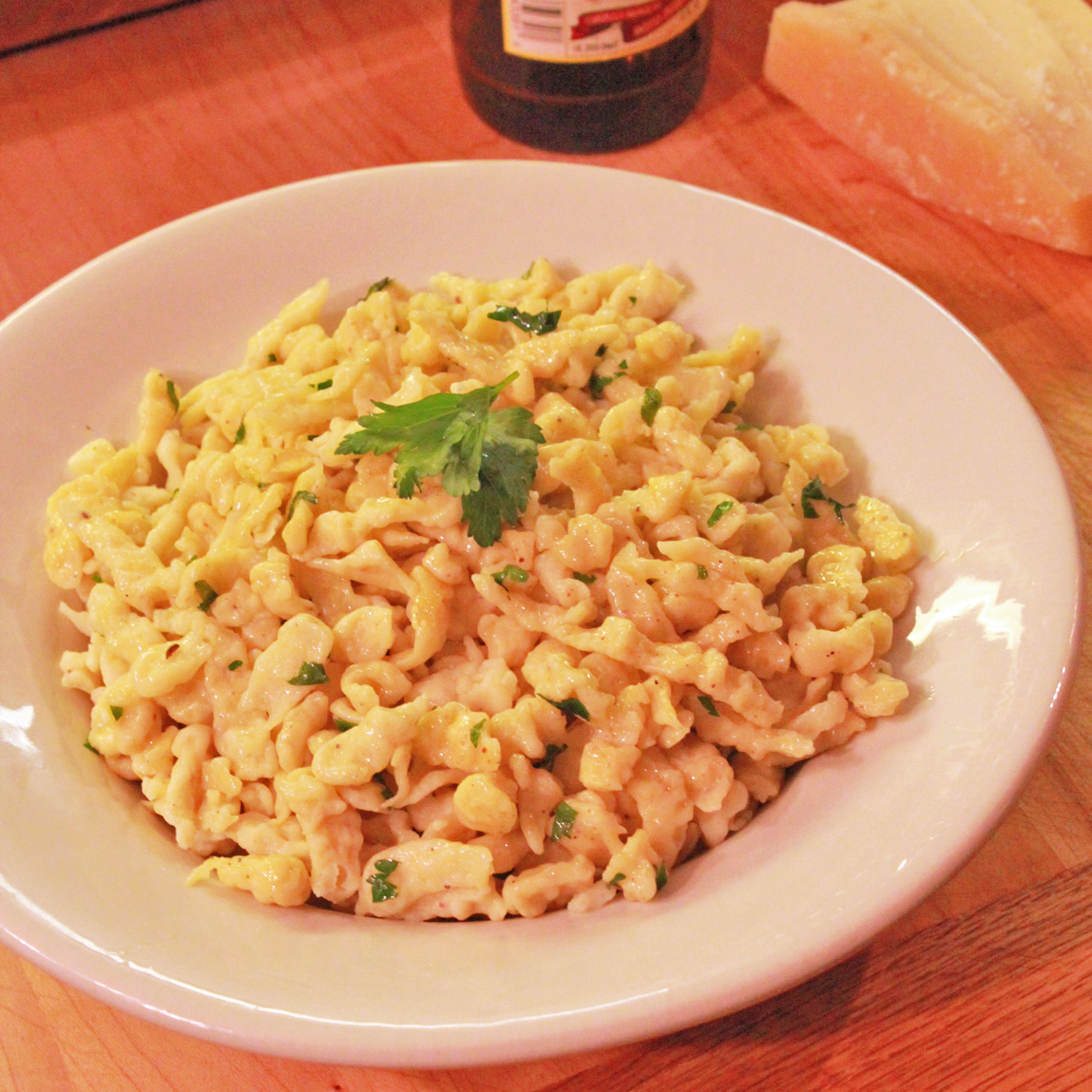
It's Spaetzle Time!

Guten Abend!

I hope everyone has been enjoying their week with Potato Pancakes! Now it's time to change things up!

Noodles are one of those food items that can be found in some shape or form all around the world. In Japan they have Soba and they have capitalized on Ramen. In Vietnam there is Pho (UW students know much about this). Of course in Italy there are hundreds of different pastas that all taste great with some kind tomato sauce! And Germany has its own special noodle too! This noodle is Spaetzle!

It is a delicious egg based noodle that is usually served with Sunday dinners. My dad grew up with Spaetzle on his Sunday dinner right next to his burnt steak that my grandfather cooked! My grandfather and grandmother were both from Bavaria and every Sunday growing up in New Jersey my father and his brothers and sister would all have to sit at the table and eat (poorly) cooked food! Auch so, my family now has special Sunday dinners that sometimes include Spaetzle!

However, I have no idea how to make it because my mom and dad were the ones who do the cooking! But! I have found a pretty good recipe that I think will meet standards in Spaetzle cooking!

The ingredients include:

14 oz of Fine Flour
1 cup of Water
3-4 eggs
1 teaspoon of salt
and some parsley

The recipe can be found at this link:  http://www.bavariankitchen.com/sides/spaetzle.aspx

I have used this recipe before and it was pretty good! Spaetzle is a noodle that can be a little heavy depending on how much butter you decide to serve it with, but it does have a fresh taste that I think most everyone would enjoy!

Now, in our German class we have been discussing different aspects of globalization and cultural integration. I don't think Spaetzle is as popular as other German foods are in America, however, lots of people can see it at a local grocery store. So it has integrated into American life. I hope people enjoy the deliciousness of Spaetzle and give a try sometime!


Looks great, right?!


Randy

TRANSATLANTIC ZOMBIES!


Zombies have taken over Berlin! The intrigue of zombie movies has become transcontinental, seeing as how this is an inevitability we must all prepare for and unite over. This was intended on being a post-Halloween post, a little late maybe, but none-the-less relevant. We should all be well versed as to how Americans handle our not-so-friendly undead friends: machine guns, flamethrowers (everyone has these), chopping off of heads, and driving around in hummers. Americans are well aware of the perils of having open wounds, untrustworthy friends, and leaving one's house alone during a zombie apocalypse. So how would Germans handle such a terrifying situation?

The 2010 German zombie film Rammbock deals with the outbreak of an uncontrollable zombie virus in Berlin. Hoping to surprise his ex-girlfriend, Gabi, with the keys to her apartment and conclude a relationship, Michael unexpectedly becomes trapped in her apartment with Gabi nowhere to be found, and zombies on the loose allover Berlin. Also trapped in her apartment is a young handyman, Harper. They communicate with the neighbors through the windows of their apartments overlooking the a courtyard. The communication between the neighbors does little to remedy any situation, or provide any sort of camaraderie because they have to yell to hear each other, and we all know zombies love loud noises nor have they learned that zombies die when you chop off their heads or hit them in the skull with an axe, as we have learned from movies like Zombie Land, and TV shows like The Waking Dead.  As the apartment complex becomes infiltrated with zombies they learn that the progression of the virus can be delayed by taking heavy sedatives. The movie gains speed as a fellow neighbor across the way ask for Michael's help to find more sedatives for his pre-zombified wife. During the fight against the zombies to find and deliver more sedatives, Michael and Harper learn several things: Gabi is alive living with her new lover in the attic (a total bummer for Michael), and that zombies are afraid of quickly flashing lights (like those from a camera flash). And with this I leave you to watch the movie, which you can find for instant play on Netflix. 
From this movie we can observe that Germans and Americans react fairly similarly during a zombie apocalypse. There is a common sense of concern for loved ones, camaraderie, and in the end, every man for himself. Germans just need to learn how to kill zombies, and they'll be OK.


Dorothy

It Takes All Kinds

Photo by Rick Bowmer, AP

The Seattle Sounders have one of the most ardent groups of supporters that I've ever experienced.  For the record, there was never a professional soccer team in my hometown of San Diego and our other sports teams are routinely below par.  Perhaps there are other MLS teams with equally enthusiastic fans but, nonetheless, I'm always impressed at the sight of a sea of blue and green on game days.
In Germany last week, a riot broke out at a DFB Cup match between Hannover 96 and Dynamo Dresden. This is the latest in a series of fan aggression in the last two decades. The following is from Deutsche Welle's report on the incident:
"Violence initially broke out before the match began when around 1,400 Dresden fans pressed against the gates at a section of the ground. Some 300 supporters then overran security officials and broke into the AWD Arena, clashing with police and delaying play for 15 minutes.
Dresden went on to lose the game 4-3 on penalties following a 1-1 draw after 120 minutes of play. After the loss, Dresden fans stormed the pitch, requiring police intervention. The violence left nine people injured and 18 fans were taken into custody."
I've done previous research on football hooliganism, such as the violence in Dresden, and I find it interesting that there are regions in Eastern Europe, South America, etc where football violence is extremely common.  But to my limited knowledge of MLS, this kind of occurrence is rare.  I asked some knowledgeable Sounders fan about fan violence before I went about drawing my own conclusions.

Point 1
There is little fan violence in the MLS as a whole.  Having spent a great deal of time in Seattle these past few years, I can vouch for the existence of fierce rivalries such as the one between the Sounders and the Portland timbers.  Rival fans will shout (often vulgar) chants at one another before, during, and after matches.  This is completely normal for the league and, some might argue, enhances the competitive environment.  But physical acts of violence don't seem to be tolerated.  In fact, my sources tell me that even the hardcore supporters' groups fpr the Sounders have a zero-tolerance policy.  This is in stark contrast to places in Eastern Europe for example where football hooligans have created a mafia-like system in places. (see Franklin Foer's How Soccer Explains the World for more on this)

Point 2
It's only fair that I make a differentiation between everyday fans of a soccer team and the die-hards (or hooligans, fanatics  whatever you would like to call them).  I love my team, FC Bayern Munich.  LOVE.  But I cannot imagine inflicting violence on another Bundesliga team or vandalizing the stadium after a particularly merciless defeat.  I'm a rational human being and this is not something I would probably ever be inclined to do.  So, please note, hooligans are a special breed.  Please don't be scared to attend your local MLS match after reading this.

Point 3
The following observation is just an observation from someone who's grown up in middle-class suburbia in Southern California.  Please don't take it as the opinion of an expert and make of it what you like.  Football is different around the world than it is here in the US.  On so many levels.  It just is.  Here it's a middle-class form of entertainment in a way.  In places in Eastern Europe, it's the working man's way of releasing whatever tensions have built up over the course of a week.  There are more academic ways of saying this but the point I'm trying to convey is that the people that follow soccer here are not necessarily the same types of people who follow Dynamo Dresden.


To conclude, soccer/football is THE beautiful game.  There will always be people who act out and threaten to ruin it for the rest of us.  And if you really want, we could have a seriously intellectual discussion on football in Europe and its numerous impacts.  I'd be down for it.  From this piece however, I hope you take away just a few things.  First of all, all sorts of people consider themselves to be fans, in  one form or another.  Hooligans are fans; they're just really extreme fans.  Second,  American soccer ≠ European football.  Third, the next time you catch a match on TV, whether it's MLS or Premier League or any other league, please watch it for more than 30 seconds.  Try and look beyond the 0-0 scoreline.  And then maybe you'll become a fan too.


My many thanks to Peter Dwersteg, Andy Fulton, and Josh Larkin for providing me with more insight into this matter than I could have ever possibly hoped for.

Bis bald!

Monday, November 5, 2012

What is it like being a German American? (Part 2)


Last Spring, My German Drama Class brought Goethe’s Stella to life on Stage. Victoria was casted as the main character Stella. Victoria, who is a Drama and Communications major at the University of Washington, is a German-American who has grown up in the Seattle area her whole life. Her bubbly personality compliments her amazing acting abilities. I will apply a youtube video of one of Victoria's monologues at the end of this interview. 

I asked to interview Victoria because I was curious what it was like growing up in a German Household in Seattle your whole life.  Unlike Jan (see my previous post), her only recollection of German culture is through her family life and occasional travel in Germany. 

Me: Where in Germany is your family from and why did they come to the United States?

Victoria: My family is from Schweinfurt, Germany. My mom is German, but my dad is American.  My mom came here because she married an American soldier (my dad).  My sister was born in Schweinfurt, but I was born here in Seattle.

Me: Do you speak German or English in your Household?

Victoria:  I speak both, for sure. I think mostly English though, but my family often mixes the two languages together. It’s weird because our German conversations start randomly. It’s fun knowing two other languages when you want talk about things in public and you don’t want anybody to overhear! (laughs)

Me: If you had a choice, would you live in Germany or the United States?

Victoria: Oh my god! Such a hard question! I think I would choose Germany. I love the cafes and the culture there.

Me: What would you say the difference is between living in a German-American household and a typical American household?

Victoria: The difference? I would say my mom makes me amazing food. She brough a lot of culture into our household. My mom always sang German tunes!

Me: Does your family celebrate any typical german traditions or holidays?

Victoria: We celebrated Fasching. Sometimes we have Fasching parties at my house. And of course we always celebrated St. Niklaus Tag. Then we would make lanterns from Lanternen Tag (Lantern Day).

Me: I asked Jan the same question, now it is your turn to answer: Was ist für dich Heimat?

Victoria: Hmm…well, home for me is being greeted by animals everyday. I have always grown up with dogs. Heimat for me is also eating food with my family and animals around. Spending times with my family and friends and being where I feel comfortable. Geez, what IS Heimat? That is such a difficult question.
____________________________________________

Here is a snippit of Victoria in Goethe's "Stella".  We applied a comedic and an american twist to this Romeo and Juliet tragedy.